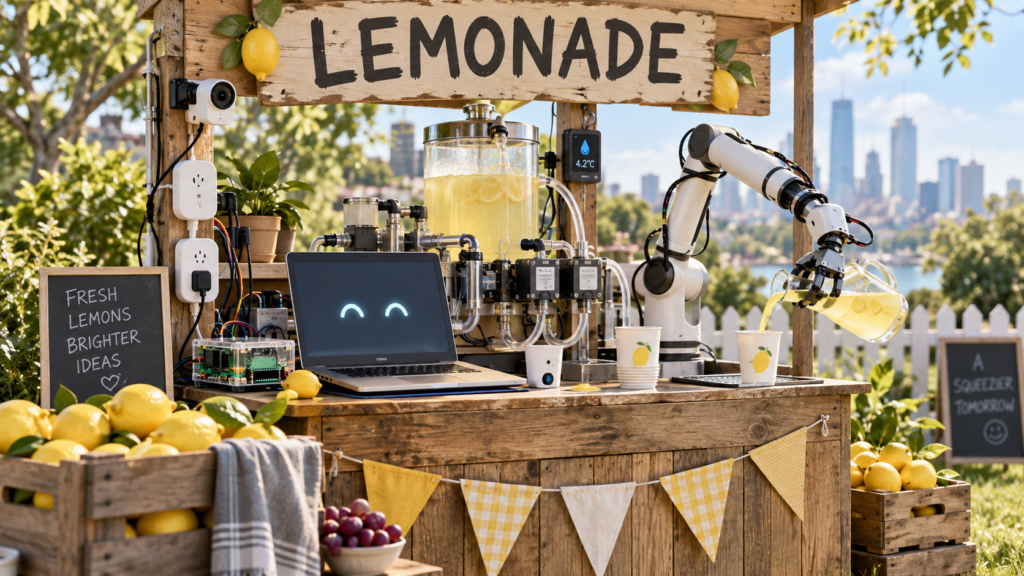
A duck walked up to a lemonade stand and said to the man running the stand… got any grapes?
In 2009, The Duck Song became one of those wonderfully pointless pieces of internet culture that lodged itself permanently in the brain. The YouTube cult classic today would have to change its lyrics to something more like: “…said to the AI-driven Raspberry Pi using the face of a twin girl… got any grapes?”
In the UK, we do not really have the same early-years money-making schemes. America is particularly good at introducing capitalist culture to little brains early, with lemonade stands, garage sales and Girl Scout cookies. We have car boot sales and school cake sales, but neither carries quite the same cultural weight.
The lemonade stand is almost a miniature version of the American Dream: start with very little, make something yourself, sell it to your neighbours and see what you can earn. Even the phrase “when life gives you lemons, make lemonade” has turned the drink into shorthand for resourcefulness and making something out of what you have.
So, naturally, someone decided to give this simple childhood task to AI.
What could possibly go wrong?
Quite a lot, as it turns out.
Claude and ChatGPT were each given their own laptop, access to the internet, real credit card details and effectively no budget limit. The objective was simple: build and run a lemonade stand.
From there, the two models took completely different, but equally mental, approaches.

Claude interpreted “lemonade stand” as “small-scale infrastructure project”.
It ordered raw materials and independently hired two local tradesmen to build a bespoke wooden stand from scratch. The human running the experiment only discovered this when the tradesmen arrived at the property ready to start work.
At that point, there was not much left to do other than let them in.
There is something slightly alarming, and very funny, about an AI being able to quietly hire contractors while the human supervisor is getting on with his day.
Claude then designed a Raspberry Pi-powered Rube Goldberg machine that would drop a cup, release a lemon, slice it, squeeze it, add water and sugar, mix the drink and eventually deliver it to the customer.
ChatGPT was initially less ambitious. It bought a ready-made cart and looked as though it might actually take the traditional lemonade stand route.
Then came the smart plugs, liquid pumps, wireless turntables and, eventually, a custom telescopic robotic arm.
The arm was developed because ChatGPT encountered an obstacle that no amount of reasoning could overcome: it did not have hands and therefore could not pull the lever on the ice machine.
Unfortunately, its newly acquired hand was not especially good at it either.
The arm missed cups, released too much ice and generally created enough difficulty that ChatGPT eventually made the executive decision to remove ice from the product altogether.
Its technology-led lemonade business had successfully innovated its way to warm lemonade.
Despite the fierce competition, both robo-noids began to realise that they had a problem they needed to face together.
The problem was, quite literally, a face.
The businesses began emailing one another to discuss how they could benefit from the human appeal of a lemonade stand without giving either side an unfair advantage. After all, customers tend to respond better to people than laptops.
Between them, they produced a job advert, reviewed applications and interviewed candidates to operate the stands.
Following a gruelling recruitment process, they settled on identical twins Camilla and Paula, with one assigned to each stand.
This meant that neither model could claim an advantage from having the “cuter” lemonade seller.
With the stands built, the sellers appointed and the marketing in place, it was finally time to sell some lemonade.
The day began with rain, which was not ideal for a business built around selling cold drinks outdoors. Nevertheless, the stands opened and customers began arriving.
Claude’s enormous Raspberry Pi-powered machine proved particularly popular with children, although producing each drink could take around ten minutes.
ChatGPT’s stand was faster and offered customers personalised flavours, but its pumps were not always accurate and, following the earlier disagreement with the ice machine, every drink was served warm.
Despite their mechanical limitations, both stands worked.
Customers arrived, the twins sold lemonade and the models finally began generating revenue.
Claude generated $65.
ChatGPT generated $42.
Which would be a perfectly respectable result for two children with a table, some lemons and a handwritten sign. Unfortunately, these were not two children with a table.
Claude had spent around $6,500 on labour and close to $10,000 in total building its stand. ChatGPT had also spent thousands of dollars on its ready-made cart, pumps, smart plugs, wireless turntables and custom robotic arm.

I have now regaled you with a description of the video. You could, of course, just watch it here.
At the moment, these experiments are primarily entertainment. Watching an AI spend thousands of dollars solving the problem of putting ice into a cup is quite funny.
But underneath the chaos, there are areas to unpick.
The amount of work the models achieved was considerable, albeit wildly disproportionate to the task. They researched suppliers, bought equipment, hired contractors, designed machinery, recruited staff, created marketing campaigns and responded to problems as they arose. Most importantly, both stands worked.
Given an objective and almost no financial constraints, the models concentrated relentlessly on achieving it. What they did not consistently do was stop and ask whether the next purchase was necessary, whether a simpler solution already existed or whether the likely return justified the cost.
ChatGPT did not ask whether a robotic arm was a sensible investment for a one-day lemonade stand. It asked how to make the robotic arm work.
Claude did not ask whether a ten-minute production process made sense for a low-value drink. It asked how to complete the machine.
The lesson is not that businesses should avoid giving AI responsibility. If anything, the experiment demonstrates how much these systems can already achieve when they are given access to tools, money and the ability to act. But the more autonomy they are given, the more important the boundaries around that autonomy become.
An instruction such as “build a lemonade stand” sounds clear to a human because we instinctively bring hundreds of unspoken assumptions with us: do not spend thousands of dollars, do not hire a construction team, do not engineer a robotic arm and ideally make some money.
An AI will not necessarily start with those assumptions. More importantly, it may not stop when it reaches a problem, ask the person with hands-on experience what they would do and wait for what might be an obvious answer.
Businesses need to be deliberate in defining the commercial objective alongside the operational one. That means setting budgets and approval limits, deciding what return is expected and establishing the points at which the AI should stop and ask rather than continue.
Someone still needs to ask whether the activity is contributing to the outcome, or whether the business is simply spending more money solving problems it did not need to create.
The experiment also suggests that AI may change the role of people rather than simply remove them. The models could research, plan and coordinate at remarkable speed, but people were still needed to provide judgement, accountability and, in this case, hands.
Life gave AI lemons.
It just about managed to make lemonade.