Back in 2012 Eton’s headmaster, the speaker at my kids’ speech day, delivered this final piece of advice to the departing Year 8 pupils: “When you are out and about, don’t look down, look up.”
In my head I pictured the wonderful detail we see on many buildings in our towns and cities: A little more expensive to create, but something from which we still benefit decades and centuries later. When labour was proportionately cheaper and Britain boomed, there was plenty of cash to show off and give off the spirit of hope.
We have been stuck in a doom loop for nearly two decades. The idea that we might spend money making buildings more interesting, when it could instead be sacrificed at the altar of public services, welfare or shareholder value, is anathema.
Of course, looking up is not only about enjoying the physical world around us. It is about raising our eyes to life’s opportunities and dangers, rather than seeing only what is presented directly in front of us, it is to think outside the box.
It strikes me that people increasingly see the world as a zero-sum game. If that boomer owns an expensive house, that must be why I cannot afford one. If that Somali who arrived on a small boat has found a job, that must be why my lad can’t. If only those lazy dole bludgers would do a day’s work, my taxes wouldn’t have to rise. Left and right have different villains, but increasingly the argument is the same: somebody else has something, therefore they must have taken it from me.
This is hardly new. Shareholders and unions, rich and poor, young and old have been at each other’s throats for as long as we have kept records. However, there does seem to be an extraordinary amount of energy currently devoted to working out how to get the most while giving the least, then blaming somebody else when the sums do not add up.
Oh, how I wish for a little national joie de vivre! A country which celebrates success, whether in business, the arts or a genuinely excellent and productive public service; where doing something well is considered worthwhile in itself and, more often than not, the money follows.
Periods of growth and prosperity have generally come when societies have lifted their heads and looked outwards. The Phoenicians did it across the Mediterranean; Venice built its wealth by connecting east and west; Britain looked beyond our sceptered isle to build the world’s greatest trading nation; today China is doing much the same. None was perfect, and none followed the same model, but all understood that prosperity comes from trade, exchanging ideas, adopting technologies and finding new markets. At the heart of all this sits the willingness to take risk and trust in the rewards. Can you imagine what Mrs Columbus must have said to him when he proposed heading west!?
At a rather more modest level, the optimism following the 2012 Olympics briefly had a similar effect. There was a huge amount of self-flagellation about the costs and risk of the Olympics beforehand, which vanished as soon as we reaped the rewards. For a moment, Britain seemed proud and open – London felt like the cultural and financial capital of the world.
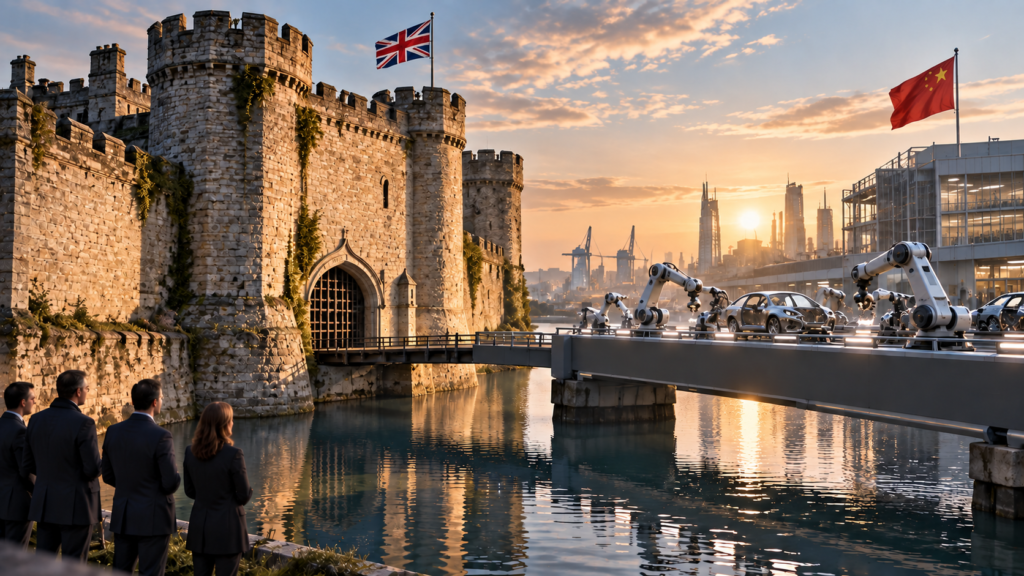
We in the west thought our high-tech engineering, creativity, brands and industrial heritage gave us a “Moat”. We assumed a burgeoning Chinese middle class would become wealthy enough to buy our expensive goods. Driving back along the A303 on Saturday, I was struck by how many of the new cars around me carried Chinese badges. Somewhere along the way, the opposite happened – BYD, rather appropriately, stands for ‘Build Your Dreams’. The Chinese have been doing just that.
While China dreams, we argue about who is going to pay for net zero, how to fund the NHS or whether we are even capable of building a railway. China has quietly transformed and no longer simply makes the cheap components that go into our expensive cars. Their newest automotive plants reportedly operate at more than 90% automation, with remarkably few people on the production line they are apparently not even lit or heated. The interesting question is no longer “how do we compete with Chinese wages?” It is “how do we create a British industrial system that can compete with Chinese productivity?”
It is time for us to look up, recognise what is happening, harness our own immense collective skills and become prepared to restructure our education system and economy, including thinking the unthinkable, otherwise we are just fiddling while Rome burns.
In business, the distinction is obvious. Companies rarely create exceptional value by spending their time deciding how to divide today’s profit and hand-to-hand combat with their competitors. They create it by lifting their eyes, understanding what their existing and prospective customers will need next, then committing creativity and capital to meeting that need. Yes, many of those investments fail, that is the nature of taking risk. Economies grow because enough succeed and that can only happen when the rewards for success are sufficient to entice more people out of their comfy existence and give it a try.
I genuinely wish Andy Burnham well, as Britain’s seventh Prime Minister in 10 years, I wonder if changing the conductor will achieve much (let alone Andy’s dream) if we continue playing variations on the same themes. Britain needs leadership that looks up and takes risk.
P.S. I hope you enjoy a few blogs the team have written this month.
Conor looks at the growing building controls market and why smarter buildings are attracting increasing attention in Keeping cool: why building controls are in the spotlight.
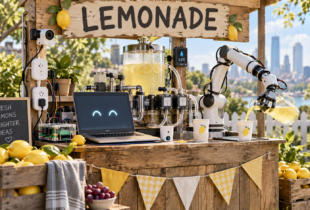
Ella takes a lighter look at AI, exploring what happens when it is given the freedom to run a business for itself in The Duck Walked Up to Two Very Expensive Lemonade Stands.
And our new recruit Toby shares the story of having his original graduate role replaced by AI – and how that experience ultimately led him to Polestar. His piece, Replaced by AI – and recruited because of it, reflects on the role AI can play in enhancing people rather than replacing them.