Our world view is of course framed by our experiences, fears, hopes, and desires. Thankfully as we better understand ourselves, we recognise our preconceptions and improve our understanding other people’s decisions. Our capacity for empathy increases as we walk in their shoes.
Can we have empathy for an inanimate object? And if so, why would we?
Our views on technology and AI, its implications, opportunities and threats are similarly framed by our preconceptions. For us to see its full potential I have the slightly whacky idea that we need to empathise with it. By empathy I clearly do not mean sympathise – I mean simply trying to understand AI on its own terms.
It is nigh on impossible to conceive all the opportunities and risks that the technology revolution / Armageddon might bring unless we try and walk in its shoes. Without doing so we cannot know its capabilities, which themselves are changing at a bewildering speed. So bewildering that the heads of Anthropic (Claude) and OpenAI (ChatGPT) are calling for a moratorium on further LLM development.
The industrial revolution in the UK really kicked off with Hargreaves’ Spinning Jenny in 1764 and spread to Europe and the US from the 1830s. Some parts of Asia are really only completing the full transition now. Humanity has had 250 years to understand and adapt from people and animals to industrial capital. Along the way there have been revolutions across nearly all geographies, with the exception of Sweden and mainland Britain which made do with a couple of luddite marches and skirmishes such as the battle of Peterloo. By 1832 we had the Great Reform Act which set the scene for today’s postmodern world.
AI and tech are equally transformational, but with a very compressed timetable and near simultaneous global impact. What previously took generations will happen in just a few years. How will governments, financial systems, and societies cope? How can we keep peace, our children employed and populations engaged, feeling secure and not disenfranchised?
We will need bold leadership with real vision. Are Musk, Page, Bezos and Huang the new land barons, chiefs, and dukes of old? If the technology concentrates wealth into the hands of the few and reduces the number of people in paid work, there will need to be a sea change in the way we collect funds from our citizens to fund society and defence.
Of course it is not purely economic, the very fabric of society is built on human interaction. Work gives us structure, income, status and meaning; it can be central to our self-worth along with real time spent with family and friends using skills we developed as children at school, in sport and at play. The more life moves online, the more deliberate we need to be about protecting the human interactions that make society work.
So back to my “off the wall” hypnosis: Empathy with AI
Empathy enables us to understand consequences before we act. If we want to perceive where AI is now and where it may take us, we need to make a serious attempt to think like it.
If we do not invest time in comprehending the technology, we may lose control in two ways. As a society, we may fail to manage the disruption. As businesses, we may fail to employ the technology effectively while competitors harness its benefits without unnecessary social fallout.
Just because technology can do something, does not mean we should use it.
Consider the mental health crisis in our young; the growth in social media and online interactions at the expense of face-to-face interactions may be a part of this. We need to be proactive, selecting where we employ technology and where we will let people do the work.
But who is “We”? It is you and me with the choices we make in our businesses, investments and private lives. It is also governments, regulators, and international institutions. The challenge, like climate change, requires both a local and transnational response. This shows up whether we choose to use a shop rather than Amazon, the UK’s intended ban on social media and the US government concerns on the power of Mythos to circumvent cyber security.
At Polestar Towers we are developing powerful capabilities using AI, machine learning and data science. The technology is enhancing the quality of our work and speed of delivery, and our plans for the next six months are both ambitious and exciting.
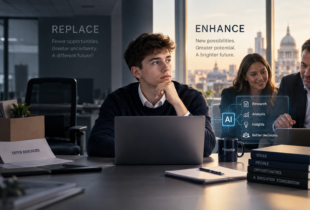
The most encouraging part is the team’s support. Colleagues say it makes their work more interesting by reducing time spent on mundane tasks. This frees up time and the energy needed to be more insightful and creative and develop higher-value skills faster. That is exactly where I think the opportunity lies: not replacing human judgment but raising the level at which people work. The nature of the work caried out by our new graduates will change but the role will remain.
If you would like to know what we are doing, drop me a line. I would be delighted to discuss it. In the meantime, the team have written a few blogs you may find of interest, which cover topics such as TikTok’s place as a sales platform, the changing shape of UK legal services and a thoughtful piece by Ella on how many careers carry invisible barriers and frustrations for a very large part of the population.
P.S. And here is a question – Will we need the Great Reform Act of 2032?And if so, how can we make it global?