
PitchBook’s 2024 US PE Middle Market Report paints a revealing picture of the M&A market and the shift we can expect to see in deal making across 2025. The dissonance between last year’s bullish reports on US dealmaking and today’s climate of uncertainty has prompted private equity firms to recalibrate. Increasingly, they are turning to British opportunities, drawn by regulatory coherence, sectoral dynamism, and separation from EU trading that has cushioned the UK in a tariff defined era.
US Mid-Market Momentum Meets Political Headwinds
2024 began promisingly for US mid-market private equity, with deal activity rising steadily across each quarter and closing at an estimated 3,316 transactions annually. EBITDA multiples climbed on both sides of the Atlantic, reflecting renewed investor appetite alongside confidence that interest rates had peaked.
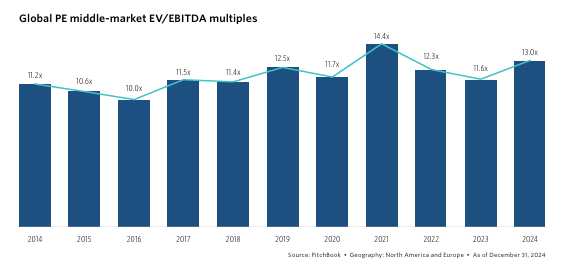
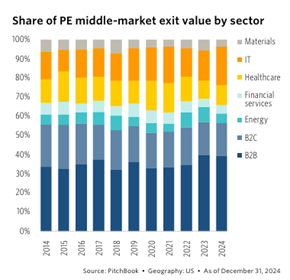
Buyouts were hit hardest in the years leading up to 2024 as higher-for-longer interest rates paired with additional headwinds, left the PE ecosystem a maze that sponsors found hard to navigate. Pressures began to ease in 2024, if they had not already which reopened the doors for sponsors to deploy dry powder, which was perfectly timed with the shifting adoption of AI that bolstered businesses efficiencies and ballooned Tech based PE activity.
The economic rebound now faces a critical test under Trump’s renewed presidency. His unorthodox policies – a blend of protectionism and improvisational tactics aimed at securing quick ‘wins’ – have injected volatility. While the S&P 500 rose steadily through 2024 and spiked 4% post-election (November 2024) on hopes of tax cuts and deregulation, optimism soon faded. By Q1 2025, inflation fears, retroactive tax proposals targeting offshore profits, and abrupt tariffs eroded confidence, leaving the index 8% below its peak (though still 20% above January 2024 levels). Manufacturing output plummeted 5.2% quarter-on-quarter – the sharpest decline since 2020 – as new trade barriers disrupted supply chains. Midwestern manufacturers, hit by 12% cost increases from steel/aluminium tariffs, began layoffs, while semiconductor shortages and CFIUS’s strict scrutiny of foreign tech investments dampened cross-border deals.
This turbulence presents an opportunity for UK firms. With investors seeking stability, the UK – leveraging its proximity and un-entanglement from the EU – could attract capital fleeing U.S. uncertainty. Whether this influx will boost European productivity and shift economic influence away from the U.S. remains uncertain, but it may ignite regional deal-making and infrastructure growth.”

The Cost of Whiplash: Reputational Risk and Retreating Capital
 The reputational toll of Trump’s MAGA policy volatility is mounting. Once seen as a bastion of regulatory predictability, the US now grapples with perceptions of capriciousness. Protectionist rhetoric collides with the realities of interconnected supply chains, leaving mid-market importers exposed. First-quarter 2025 data reveals a 15% drop in US mid-market deal closings, with valuation discounts emerging in sectors reliant on global trade. Meanwhile, institutional investors are voting with their capital: 67% of US pension funds and insurers reduced domestic allocations in early 2025, redirecting billions to Europe and Asia. CalPERS’ $3 billion pivot to European infrastructure and UK renewables epitomises this flight to stability – a trend accelerating as Trump doubles down on tariffs. His proposed 10% universal levy, paired with sector-specific duties, threatens to inflate costs and fragment supply chains further. For PE firms, the calculus is clear: the rewards of some US deals no longer justify the political risk.
The UK’s Allure: Precision, Pragmatism, and Price
Herein lies the UK’s opportunity. Post-Brexit, the UK is left finally left with upside that may sharpen its competitive edge, as an ally cushioned between the EU and US, insulated against the worst of the crossfire. The Competition and Markets Authority (CMA) now outpaces the US Federal Trade Commission in mid-market merger reviews. Regulatory clarity, coupled with sector-specific pragmatism, has fuelled a 15% year-on-year FDI rise in early 2025.
The figures reflect deeper strengths: for years now, we have seen stable-growing-UK businesses acquired at significantly competitive multiples, against compressed UK valuations, when an overseas party is involved. There is opportunity for this momentum to continue and close the gap between weaker UK valuations against highly valued American peers. With a relatively weak valuations on our stock market, UK listed companies may be rich picking for UK equity houses, especially those with US$ income.
Sectoral depth compounds this advantage. Once overshadowed by Silicon Valley’s scale, Britain’s fintech, biotech, and green energy sectors now command attention, attracting $9.5 billion in US PE funding last year alone. These industries thrive under a cross-party consensus on innovation and decarbonisation—a stark contrast to America’s antitrust battles and valuation froth. The green agenda is globally incoherent, international investors and businesses require ESG based reporting to secure funds in Europe that satisfy EU investors. The US offers no continuity across states, which breeds nervousness in investors. International investors tied into international reporting regulations must now make the decision on what to back, and where.
PitchBook’s analysis of subsector specialisation underscores the shift: UK-focused PE firms, leveraging vertical expertise, are unlocking value through operational precision rather than financial engineering. The result? Post-acquisition returns that increasingly outpace transatlantic peers – an ongoing trend we expect to continue over the next 5 years.
So, will the UK market balance out against its previously pumped-up ally? If investor confidence grows in the UK market, UK multiples could increase, driving competition and the value of UK assets.
A Strategic Pivot for Uncertain Times
Whilst the US marker backdrop has been increasing in risk, the UK whilst flat, is stable. In a Trumped up world stability is an attractive feature for investors as they look to reallocate their assets.
For UK business owners hoping to exit, the implications are compelling. As US mid-market valuations wobble under tariff threats and antitrust scrutiny, British firms command premium interest. The confluence of regulatory foresight, sectoral innovation, and geopolitical insulation has positioned the UK as a rare constant in a volatile landscape. Domestic manufacturers, source over 50% of inputs locally or from the EU, sidestep Trump’s import levies entirely.
At Polestar, we observe this daily: international investors, are partnering with UK enterprises to build resilient, high-growth portfolios, that are flush against international regulations, and cushioned from tariff cross fires
| Factor | US Challenge | UK Advantage |
| Policy Stability | Erratic tariffs and retroactive taxes | Cross-party consensus on innovation, green growth |
| Regulatory climate | FTC delays, politicised antitrust, lack of congruity across different states | CMA’s speed, sector-specific pragmatism |
| Sector Depth | Tech/ healthcare valuations stretched | Fintech, biotech, renewables at |
The question is not whether the UK’s moment will endure, but how swiftly global capital will adjust to this new equilibrium. In an era of fragmentation, Britain’s blend of openness and stability offers something increasingly scarce—a strategy for certainty.
For further discussion on navigating this shifting terrain, Polestar’s team stands ready to explore high-value opportunities tailored to the transatlantic divide.