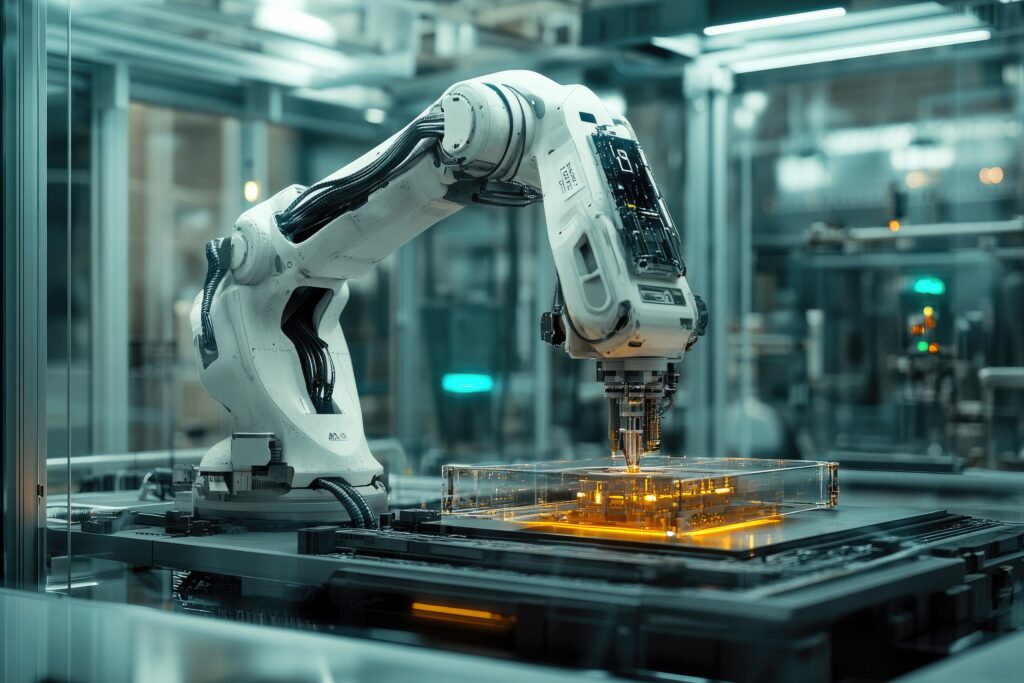
When I visit clients’ manufacturing businesses, I Iove that familiar rhythm: machines humming, skilled operators solving problems on the fly, spreadsheets tracking jobs, and a factory owner juggling customer demands, cash flow, and compliance.
Artificial intelligence and machine learning can feel a world away from this reality, more the domain of Silicon Valley or global automotive giants, not a 75-person precision engineering firm in Woking. But AI is no longer an abstract promise. Costs have fallen, tools are easier to access, and support programmes exist specifically to help Eddystone members and Polestar’s clients. The opportunity is not just for the FTSE 100: it is for the smaller PE backed or family-owned manufacturer wondering how to stay competitive in a market of rising energy bills, labour shortages, and fragile supply chains.
The question I get is “Where do we start?” quickly followed by “We don’t want to waste time and money on technologies that promise the earth but fail to deliver!”
Start with your pain points – Not with “AI”
Too many conversations about digital transformation begin with technology rather than problems. We should flip the logic: identify one costly or frustrating issue in the business and then ask whether AI can help address it.
The usual suspects are easy to spot:
These are the kinds of operational headaches that AI tools can relieve, and they do not require a team of data scientists or a seven-figure IT budget.
Practical Entry Points for AI in Manufacturing
Predictive Maintenance
The concept is simple: fit inexpensive sensors to a critical machine and use machine learning models to predict when it is likely to fail. This allows servicing before breakdowns, smoothing production schedules and reducing costly downtime.
Cloud platforms now offer predictive maintenance as a subscription service. An SME can trial this on one or two machines for a modest outlay, often less than the cost of a single day’s downtime.
Quality Control with Computer Vision
You know that quality and inspection is one of the most repetitive and error-prone processes on your shop floor, but how can AI help? AI-driven image recognition systems can now run on low-cost cameras linked to a laptop or edge device. They can detect scratches, colour deviations, or shape errors faster and more consistently than the human eye.
A small pilot may cost a few thousand pounds – but if your business regularly loses batches to quality issues, the payback can be rapid.
Inventory and Demand Forecasting
Forecasting demand and managing stock has always been more art than science. Machine learning models can take historic sales data, seasonality, and customer behaviour and generate sharper predictions than Excel averages.
The difference is not theoretical: even a 5 -10 per cent improvement in forecasting accuracy can release working capital tied up in slow-moving stock. Off-the-shelf forecasting apps, many cloud-based, make this achievable without deep technical knowledge.
Energy Optimisation
AI can analyse energy consumption patterns across a factory and flag inefficiencies – whether a compressor left running idle, or a process that spikes at peak tariff times. With energy bills a major concern in the UK, even small gains can improve margins.
Several providers now offer AI-driven energy dashboards aimed specifically at SMEs.

Cost-Effective Adoption Tactics
Most manufacturers underestimate the value of the data they already collect through e.g.: machine logs, production spreadsheets, quality records. These can form the raw material for AI models, without expensive new systems.
Choose one problem, one production line, one machine. Run a time-bound pilot for say three months, not three years. Measure outcomes and only then consider rolling out more broadly.
Cloud services mean you no longer need to buy servers or employ IT staff to host software. Pay-as-you-go models reduce upfront costs and make it easier to scale down if a pilot disappoints.
Owner-managers need not go it alone. The UK’s Made Smarter programme [link] offers funding, advice, and student placements to help SMEs adopt AI and other digital tools. Digital Catapult and the High Value Manufacturing Catapult also run testbeds where firms can trial new technology before committing capital. Local Growth Hubs and universities often run voucher schemes or offer graduate talent at subsidised rates.
Adopting AI is not just a technical project; it is a cultural one. Many SME owners worry that they lack the skills internally. The answer is not to hire an expensive data scientist from day one, but to appoint a digital champion inside the business: Someone curious about technology, close to operations, and capable of spotting where AI might help. For Polestar it has been a recent graduate who loves this stuff.
Staff engagement is critical. Present AI as a tool that augments rather than replaces skilled people. A machinist who knows a lathe inside out is still vital; AI simply helps anticipate problems before they occur.
Training should be practical and confidence-building, not theoretical. Even a half-day introduction to AI concepts for supervisors can demystify the topic and reduce resistance.
Managing Risks
The risks are real but manageable if you approach adoption with eyes open:
The Business Case
It is your cash so return on investment matters more than the joy of algorithms. AI must demonstrate payback in terms of reduced downtime, higher yield, lower stock, or lower energy bills.
Evidence is growing that it does. The Made Smarter North West pilot reported that many SMEs achieved double-digit productivity improvements from relatively modest digital projects, often underpinned by AI. Case studies from Digital Catapult show similar outcomes in areas such as predictive maintenance and supply-chain visibility.
The crucial point is that AI can deliver incremental, tangible benefits at your scale — not just transformational visions for multinationals.
A Pragmatic Roadmap for Owner-Managers
Conclusion: The Time to Experiment Is Now
For UK manufacturers, the temptation is often to wait until the technology is proven and the risks feel lower. But the cost of waiting is rising competitors in Europe, Asia, and the US are already embedding AI into their factories. The UK is falling behind our competitors as only 36% of companies are using it in their manufacturing process.
The good news is that entry costs have fallen, support is available, and the first steps can be modest. AI is no longer the preserve of the giant or the glamorous. It is a practical tool to help a British manufacturing business run more efficiently, serve customers better, and free up the owner’s time from firefighting to strategic thinking.
You do not need a PhD in machine learning. You just need the courage to start with one problem, one pilot, and one clear outcome. From there, the path opens up.
Made Smarter Review: Industrial Digitalisation Review
Future Factories Powered by AI
Annual Review 2023-4: Delivering Impact at Scale
ISCF Made Smarter Innovation Challenge: Final Evaluation Report