It goes without saying that for business to thrive it needs to invest. But when cash is tight and the future feels uncertain, it is understandable that manufacturers feel cautious about committing capital.
However, a failure to invest appropriately will eventually lead to a less competitive, less valuable business – and sometimes, the greatest opportunities arise precisely when confidence is low and uncertainty is high.
There are certainly signs that the UK’s manufacturing investment environment has become more challenging. According to Make UK’s Investment Monitor 2026, some 56% of manufacturers believe the UK has become a less attractive investment destination over the past five years. This sentiment is reflected in realised investment levels: investment intensity (investment as a share of turnover) for plant & machinery declined from 8.1% in 2024 to 6.4% in 2026, a relative decline of 21%. Similarly, R&D investment intensity fell from 6.5% to 5.1%, a 22% relative decline.
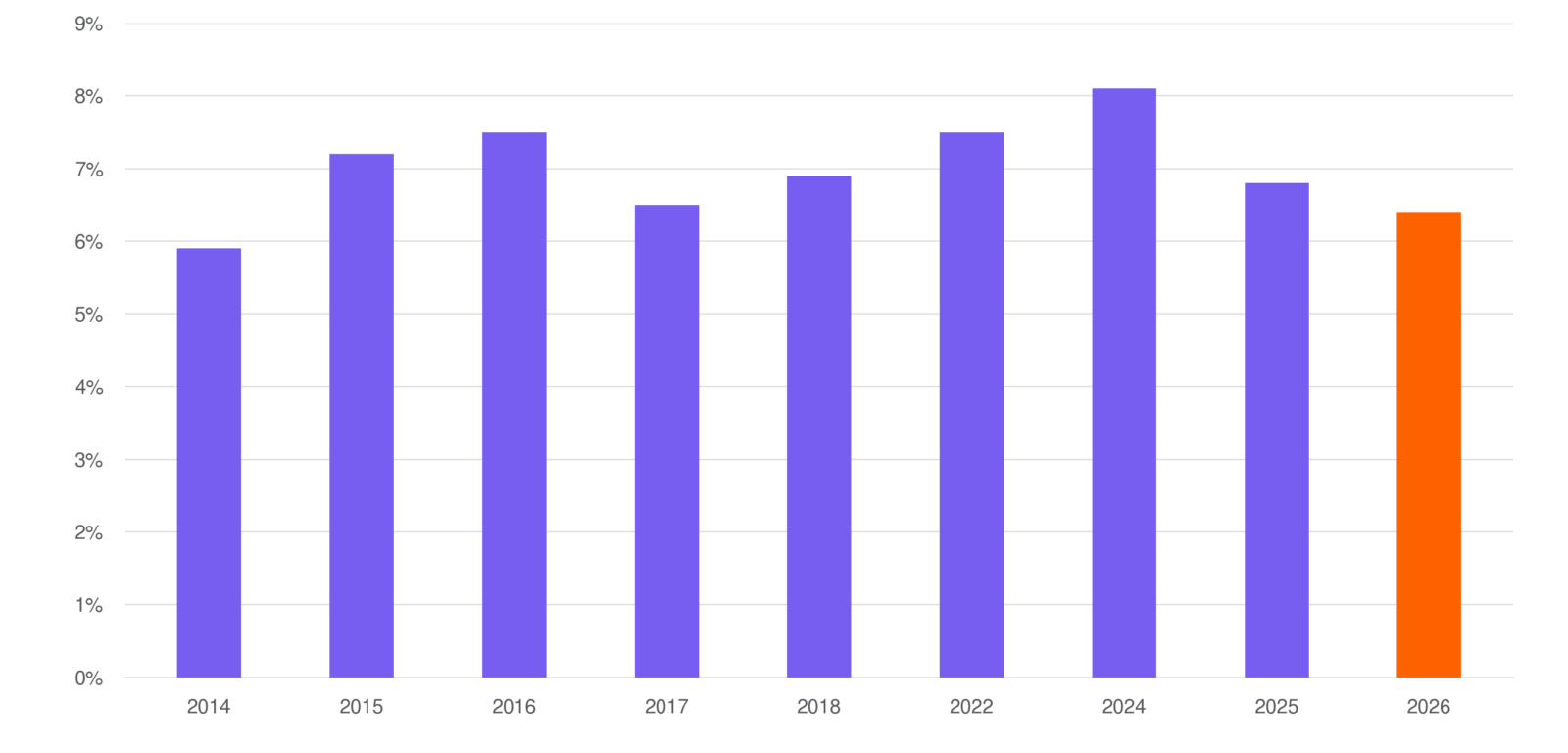
Source: Make UK, Investment Monitor Survey 2026
There is substance to the decline. Rising operating costs, taxation, higher energy prices, and geopolitical uncertainty are undoubtedly eating into margins. In 2024, UK industrial electricity prices were the highest in the G7, while subsequent increases in employers’ National Insurance Contributions and the minimum wage have added further costs, leaving less capital available for investment. We have all experienced the effects of this, but few sectors have been hit harder than manufacturing.
But are there any reasons to be more optimistic than the headlines might suggest?
First, we should consider these numbers within the historical context. Plant and machinery investment intensity had previously risen from a post Brexit vote low of 6.5% in 2017 to 8.1% in 2024, potentially also encouraged by tax incentives introduced under Jeremy Hunt and subsequently retained by Labour. Whilst the latest 0.4% decline is still relatively modest by historical standards, it is the continuation of a downward trend since peaking in 2024.
Secondly, alternative sources can be used to support a slightly more optimistic perspective. ICAEW’s Q3 2026 Manufacturing and Engineering monitor found that UK manufacturers reported annual sales growth of 2.6%, alongside capital investment growth of 3.0%. This suggests that investment intensity actually rose rather than declined, a more positive picture than Make UK’s figures alone might imply….Lies, damn lies and statistics!
The allocation of investment is likely changing too – The potential reallocation of expenditure from say machinery to AI might produce a short-term downward swing as businesses await greater certainty on direction of travel before committing to increased capex, on either equipment or AI.
Such caveats aside, sentiment across business owners remains real and what they report reflects their intentions. True, the statistics may not tell the whole story or confirm sustained investment contraction. However, Make UK has flagged genuine pressures on, and consequently concerns of, manufacturers and this should prompt some serious questions as to how to address these to boost investment and ensure the sector continues to thrive going forward.
There are some encouraging signs in manufacturers’ investment intentions. To remain competitive, many manufacturers have a programme of regular investment and, despite the 56% who say the UK has become less attractive for investment, unsurprisingly, the majority (62%) say that, if they were to consider increasing their capacity in a major way in the next 12 to 24 months, they would still do so domestically, though a meaningful 23% did say they would look overseas.
Confidence is particularly important here. The most frequently selected investment influence remains ‘confidence that domestic demand has improved’ at 37%.
These are great examples of what the famous economist Keynes termed animal spirits – investment decisions are driven not just by costs and financial calculations, but by confidence in future opportunities. Manufacturers’ investment decisions are particularly sensitive to expectations and market sentiment which can change rapidly even without corresponding changes in underlying economic conditions. After all, why would an owner take a risk unless they were excited by the prospect of a real reward?
Perhaps the report’s most interesting finding concerns artificial intelligence.
Some of the decline in investment in both plant and machinery and R&D may simply reflect shifting investment priorities. 41% of manufacturers now say they are prioritising AI investment, up from 27% in 2025, placing it alongside machinery and production skills for the first time. Make UK suggests this may be diverting expenditure away from traditional capital investment and R&D.
Higher labour costs will undoubtedly be encouraging precisely this shift towards automation and productivity-enhancing technology as businesses seek to protect margins. We are seeing how the very significant Chinese investments in automotive manufacturing are reshaping global competition in that market. Overall Chinese investment levels of c.12% are essentially double those quoted for the UK. There is an opportunity for the UK to replicate that investment drive, and potentially at a better rate of return given AI acceleration, particularly in its world leading defence, aerospace and computing industries.
Make UK’s report captures very real pressures facing UK manufacturers. Rising employment costs, higher energy prices, and geopolitical uncertainty can all constrain investment, as owners seek to protect downside risk by retaining (or having to retain) cash, preventing great opportunities from being seized.
However, the wider picture is not uniformly negative. Manufacturers continue to express a preference for domestic expansion, emerging technologies offer opportunities to improve productivity and competitiveness, and other sources suggest investment activity has grown.
For manufacturing businesses considering their long-term future, the distinction between investment sentiment and investment performance is particularly relevant.
Investment can strengthen a business’s competitive position, but its value ultimately depends on the returns it generates. New machinery, automation and R&D may improve productivity, reduce dependence on labour and protect margins. Equally, as is often the British way, sustained underinvestment can leave a business with ageing equipment, reduced capacity and increasing costs.
These considerations become especially important when assessing a manufacturer’s long-term value. Prospective buyers will be interested not simply in how much a business has invested, but in whether that investment has translated into sustainable earnings, competitive advantage and opportunities for future growth. Where there has been under-investment, buyers may reduce the price to reflect the capex required to maintain and build the business.
In this uncertain investment environment, a manufacturer’s ability to demonstrate the returns on its investment may prove more important than the prevailing sentiment across the sector. Those able to look beyond today’s uncertainty and identify opportunities for long-term growth are likely to be best positioned to prosper.